
Ferrari has built its reputation on one principle. The brand builds cars and nothing else. For decades, the idea of a Ferrari motorcycle was dismissed as impossible.
Yet in the 1990s, a single Ferrari motorcycle was created legally, officially, and with written permission from the Ferrari family.
The project began when David Kay, a highly respected MV Agusta specialist, wrote directly to Piero Ferrari, Enzo Ferrari’s son, requesting approval to build a one off motorcycle as a tribute to Enzo Ferrari. The request was not casual, nor was the response.
In a letter dated May 23rd 1990 in Maranello, personally signed by P. Ferrari, Kay received official approval to place the Ferrari badge on his motorcycle, along with a message wishing him success with the project. That letter remains part of the bike’s documented history.
No other motorcycle project before or since has ever received such authorization.
With approval secured, Kay committed to building the motorcycle entirely from scratch. His vision was shaped by both Ferrari’s past and an imagined future, asking what might have been if Ferrari had ever produced a GT or endurance racing motorcycle. Kay was also inspired by the fact that Enzo Ferrari began his racing career on a Scott two stroke motorcycle, adding a deeper historical connection to the project.
What followed was four years of work and more than three thousand man hours of engineering.
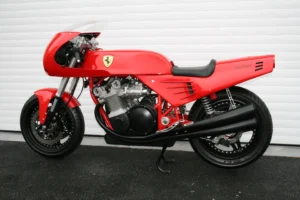
The finished machine became known as the Ferrari 900.
This was not a modified production motorcycle. At its heart sat a scratch built 900cc transverse four cylinder engine with double overhead camshafts and eight valves. Magnesium and alloy casings housed the engine, which was paired with a five speed gearbox.

The motorcycle was built around a tubular chassis made from Reynolds 531 steel tubing, with engineering quality described as irreproachable. Attention to detail was extreme. The master cylinder was integrated directly into a one off digital instrument panel, while components such as the steering damper were crafted with equal precision.
The entire aluminium bodywork was produced by Terry Hall, including the distinctive double curvature reverse cone megaphone exhausts. Kay famously described the sound as resembling a Messerschmitt chasing a Spitfire, a fitting description for a machine built with both aggression and elegance.
The front suspension featured Forcelle Italia upside down forks, while braking was handled by Brembo disc brakes front and rear, with six piston callipers at the front and four piston callipers at the rear. The bike rolled on 17 inch hand spun Astralite wheels, with WPS twin rear shock absorbers completing the setup.

After four years, the Ferrari 900 was tested, though never pushed to its absolute limits. Performance figures were still remarkable. The engine produced 105 horsepower at 8,800 rpm, with an estimated top speed of 265 km h. Dry weight was an exceptionally low 172 kilograms.
The motorcycle quickly gained international recognition. It was featured in major publications including Scuderia in Japan, Themen and Trends in Germany, Motociclismo in Italy, SM30 in Spain, and Motor Cycle News in the United Kingdom, as well as a prominent color feature in The Daily Telegraph. It was also highlighted in Mike Walker’s book The MV Story, appeared on multiple television programs, and was exhibited at events such as the Coventry Classic Bike Show.
For most of its life, the Ferrari 900 was kept indoors and regarded as a unique work of engineering art rather than a conventional motorcycle. Eventually, its owner decided the time had come for it to find a new custodian.
In an era dominated by mass production, the opportunity to own an officially acknowledged, one off tribute to Enzo Ferrari is unlikely to ever appear again. The Ferrari 900 remains the only motorcycle Ferrari officially allowed to exist.
One exception approved by the family. And a rule that has never been broken again.